LevelUp Living
I led the product vision and learning experience design for LevelUp Living, a scenario-based platform that teaches real-world life skills through interactive simulations. I worked across product strategy, gameplay systems, and UX to create scalable learning experiences grounded in educational theory and user engagement.
Watch our live pitch!
Role
Product Manager, Learning Experience Design
team
Molly Yang + me!
timeline
Jan 2026 to Present
THE PROBLEM
Life-skills education is often passive, forgettable, and reactive.
Passive learning doesn’t build confidence.
Most life-skills education relies on lectures, videos, or PDFs that learners quickly forget without real practice.
Real-world mistakes carry real consequences.
Young adults are often forced to navigate emergencies and high-pressure situations for the first time in real life.
There are few engaging tools for practicing decision-making safely.
Existing resources rarely allow learners to actively explore scenarios, make mistakes, and learn through experience.
THE RESEARCH
People learn best through experience, feedback, and reflection.
To better understand how people build confidence in real-world situations, we explored research across learning science, game-based learning, and experiential education. We found that effective learning experiences consistently shared three principles:
1
Active participation
2
Immediate feedback
3
Low-stakes experimentation
>25,000
monthly searches for how to handle basic home problems
2 in 5
Americans can't fix any home maintenance problems without the internet
THE SOLUTIONS
Designing for decision-making
Instead of presenting information through static lessons, we designed interactive scenarios where players assess situations, choose actions, and experience consequences in real time. This transformed learning from memorization into active problem-solving.
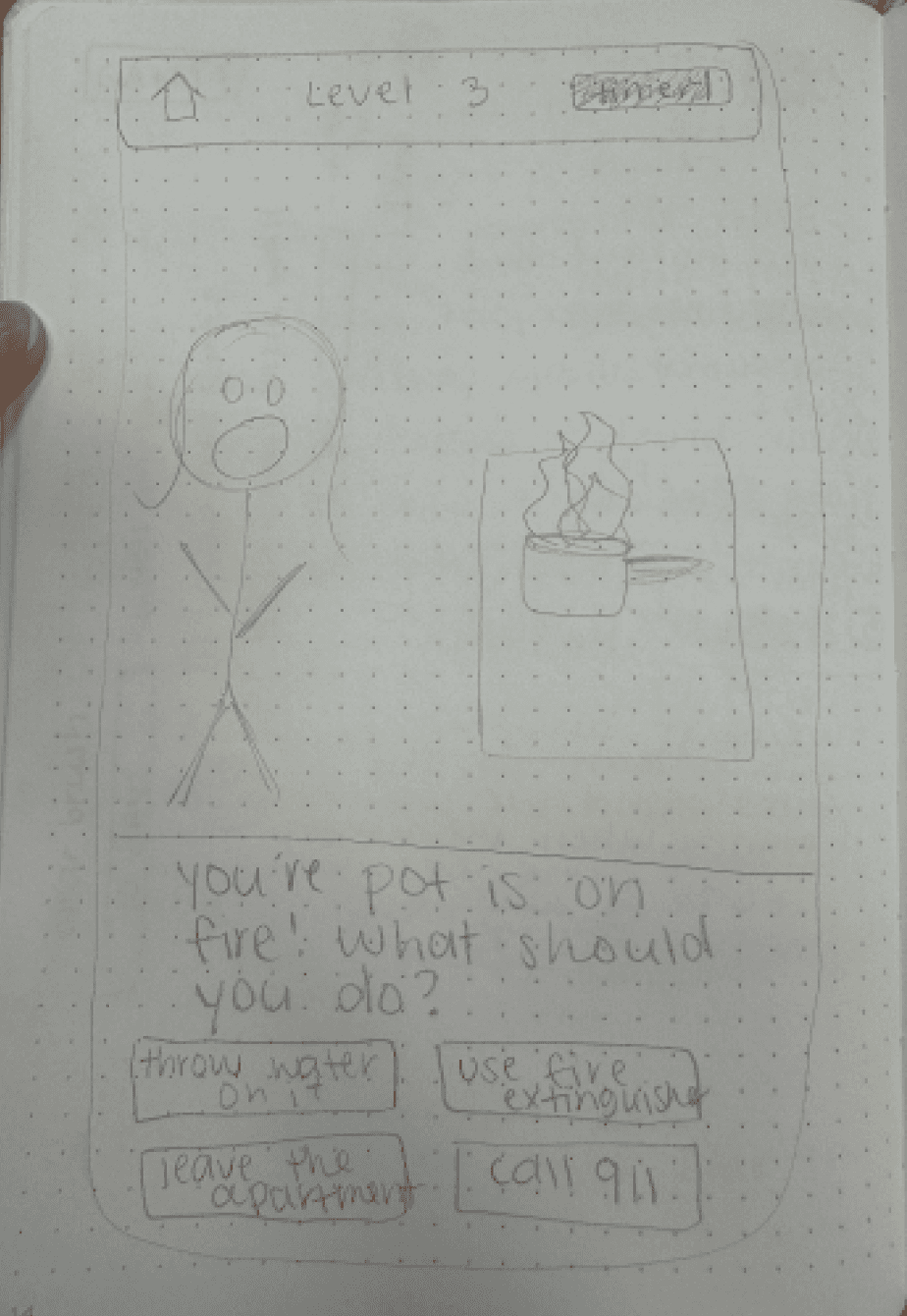
Paper sketches helped us pressure-test the core interaction early -- could a four-choice format communicate real stakes without overwhelming the player?
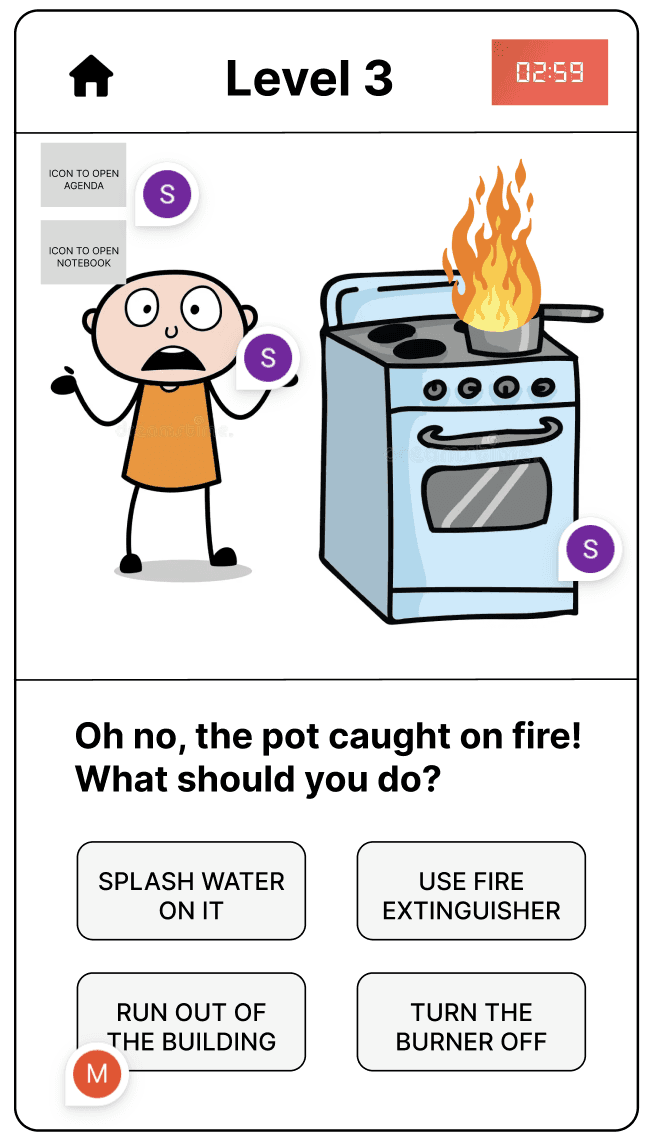
We moved to high-fidelity quickly to test whether the scenario felt urgent and grounded, not gamified or trivial.
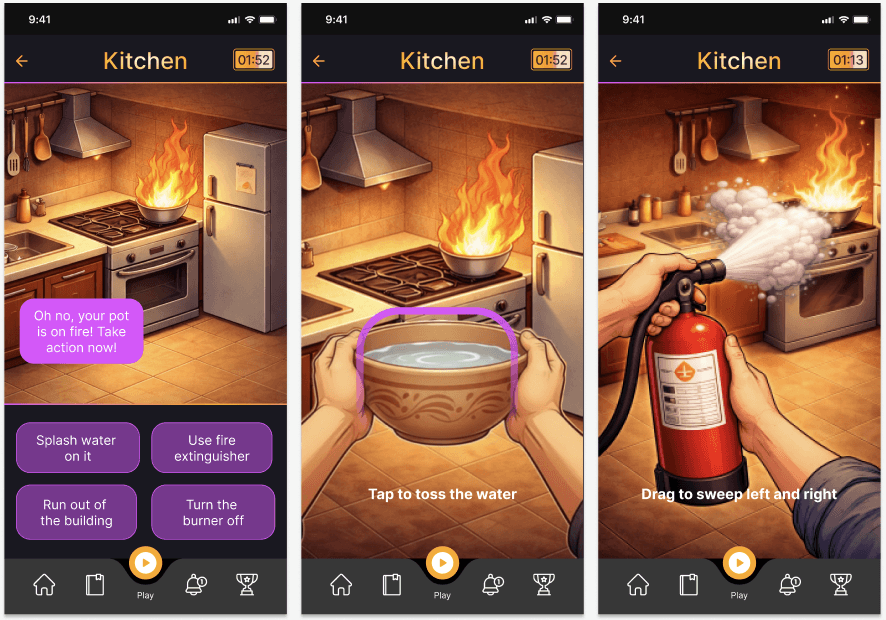
Shifting to a realistic kitchen environment made consequences feel tangible. Players needed to believe the situation was real for the learning to stick.
THE SOLUTIONS
Reinforcing learning through feedback
We built a feedback system that immediately showed the outcomes of player decisions while encouraging reflection rather than punishment. Correct choices reinforced confidence, while mistakes became opportunities to retry and learn safely.
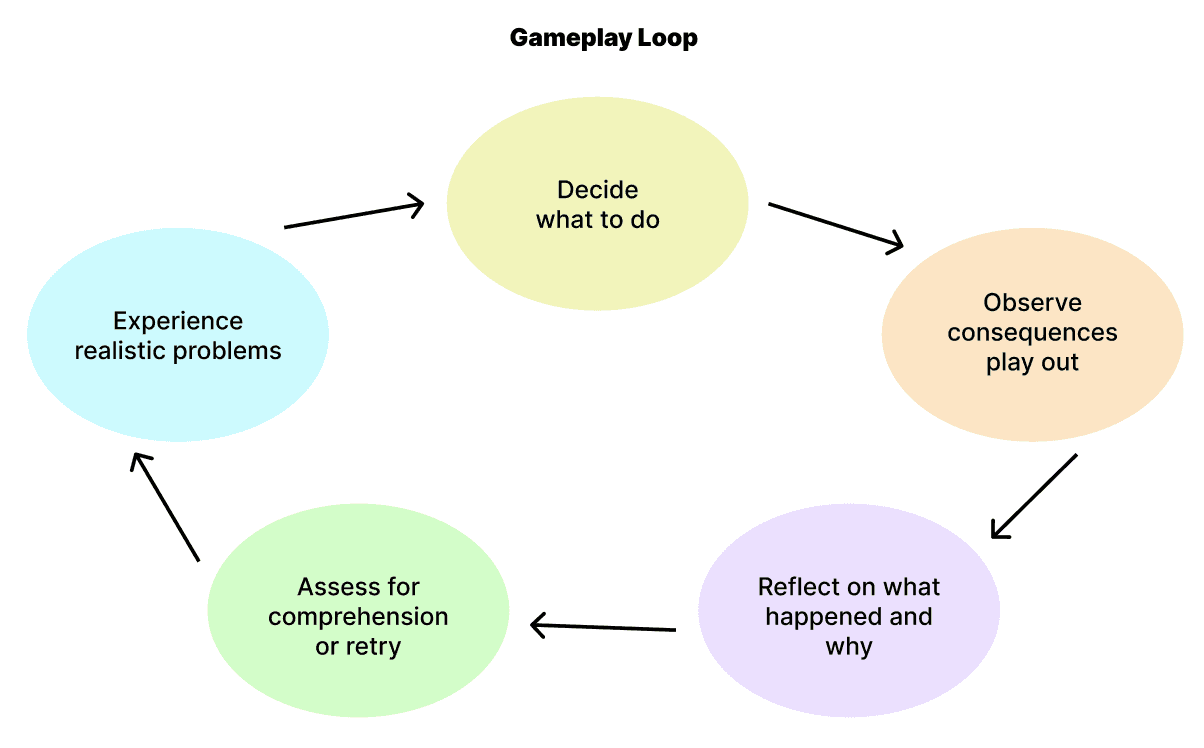
We mapped the full decision loop before designing individual screens, ensuring reflection and retry were built into the system.
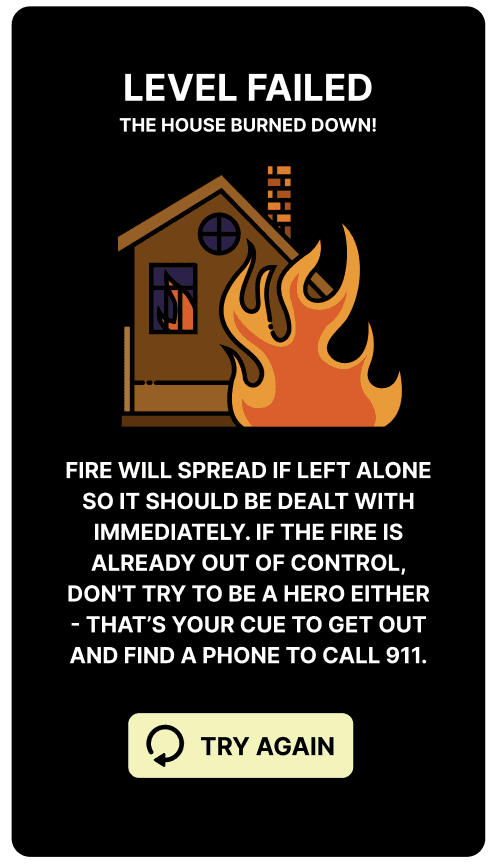
Failure needed to feel consequential but not punishing. The screen had to communicate 'this matters' while still inviting the player back.
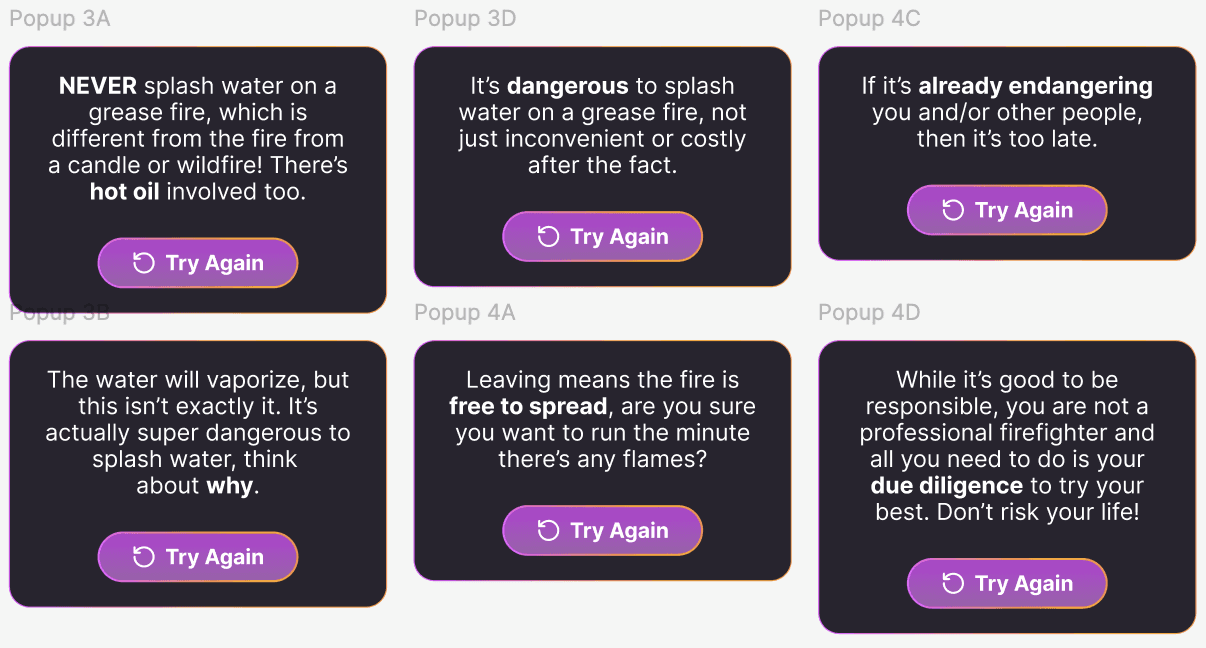
We wrote six distinct feedback variations per wrong choice to ensure explanations were not generic -- the wrong reason for a wrong answer teaches nothing.
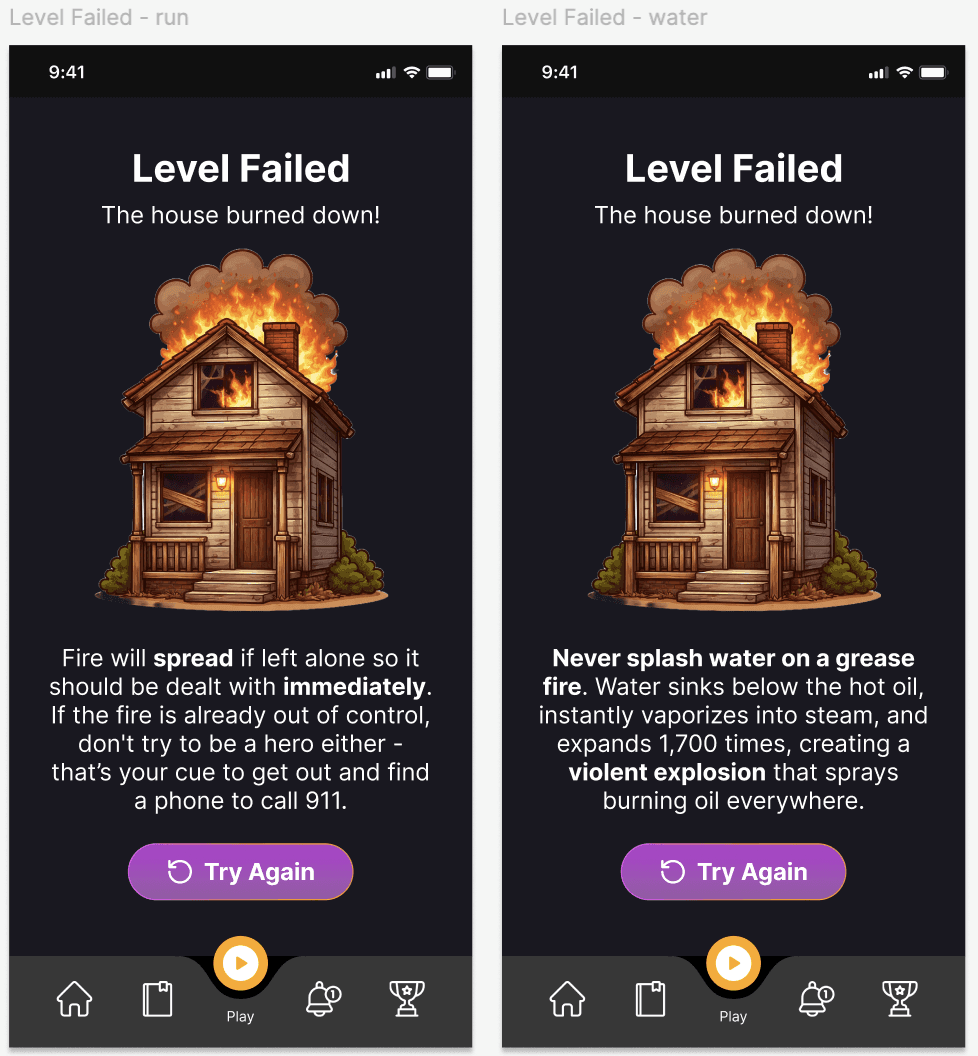
Final failure states were tailored by choice, so players received targeted feedback rather than a one-size-fits-all explanation.
THE SOLUTIONS
Making learning feel engaging, not educational
A major design challenge was balancing educational structure with an experience that still felt playful and immersive. We explored notebook metaphors, progression systems, level transitions, and interactive animations to create an experience that felt approachable rather than classroom-like.
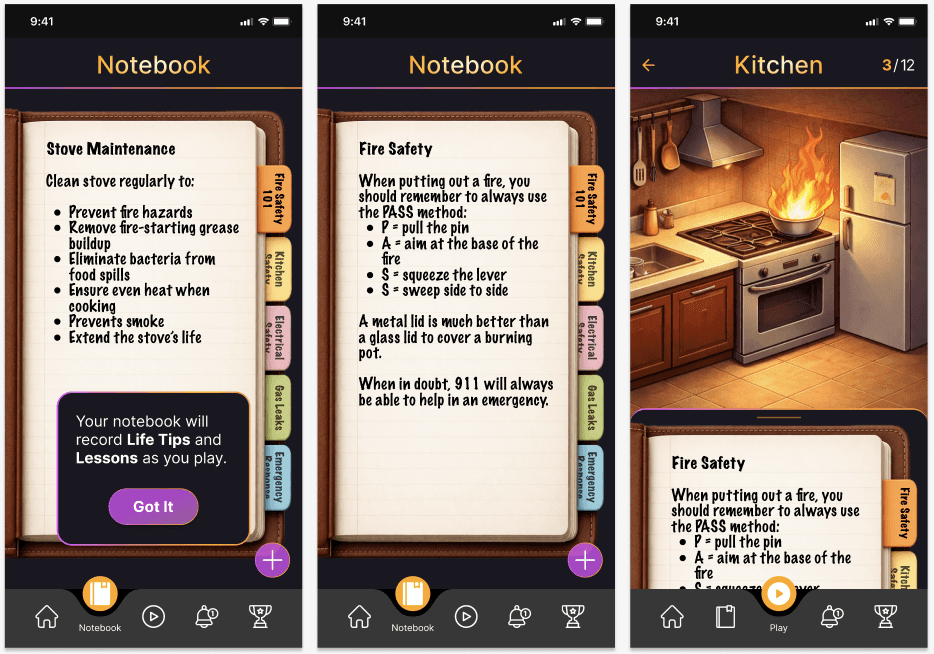
The notebook gave learning somewhere to live outside the scenario -- a reference that felt earned, not assigned.
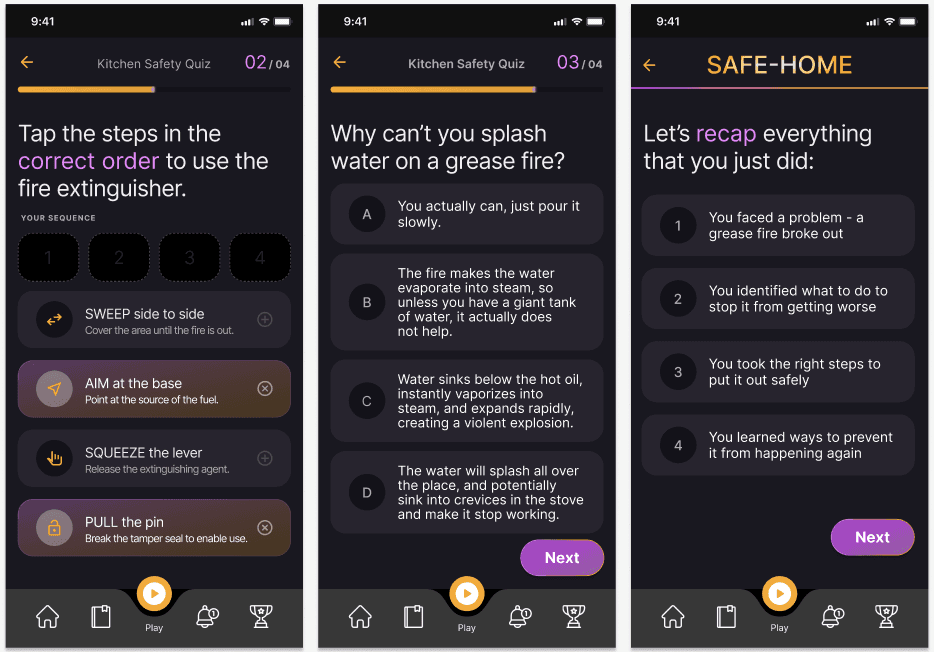
We added a post-scenario quiz and recap to close the loop: players could name what they learned, not just feel it.
MY Impact
Translated learning science into an interactive product system.
I led the product strategy and experience design for LevelUp Living, shaping everything from the learning framework and gameplay loop to the interaction patterns and scalability model. Beyond designing individual screens, I focused on building a modular system that could support future scenarios, educational partnerships, and long-term platform growth.
Reflection
Designing educational experiences taught me three lessons.
1
Engagement is part of learning.
If an experience doesn’t capture attention, even strong educational content can fail to resonate.
2
Feedback shapes confidence.
The most meaningful learning moments came from allowing players to safely fail, reflect, and retry.
3
Systems matter as
much as screens.
Designing LevelUp Living pushed me beyond interface design into thinking about scalability, pedagogy, progression, and long-term product strategy.
AWARDS
James A. Kelly Learning Levers Prize - Marsal Family School of Education, University of Michigan, April 2026. A competitive pitch event challenging UMich students to build research-based digital tools that improve pre-K–12 learning. LevelUp Living was selected as a finalist and received a $2,000 Development Award to support further building of the platform.

Sami and Molly at the James A. Kelly Learning Levers Prize, April 2026.
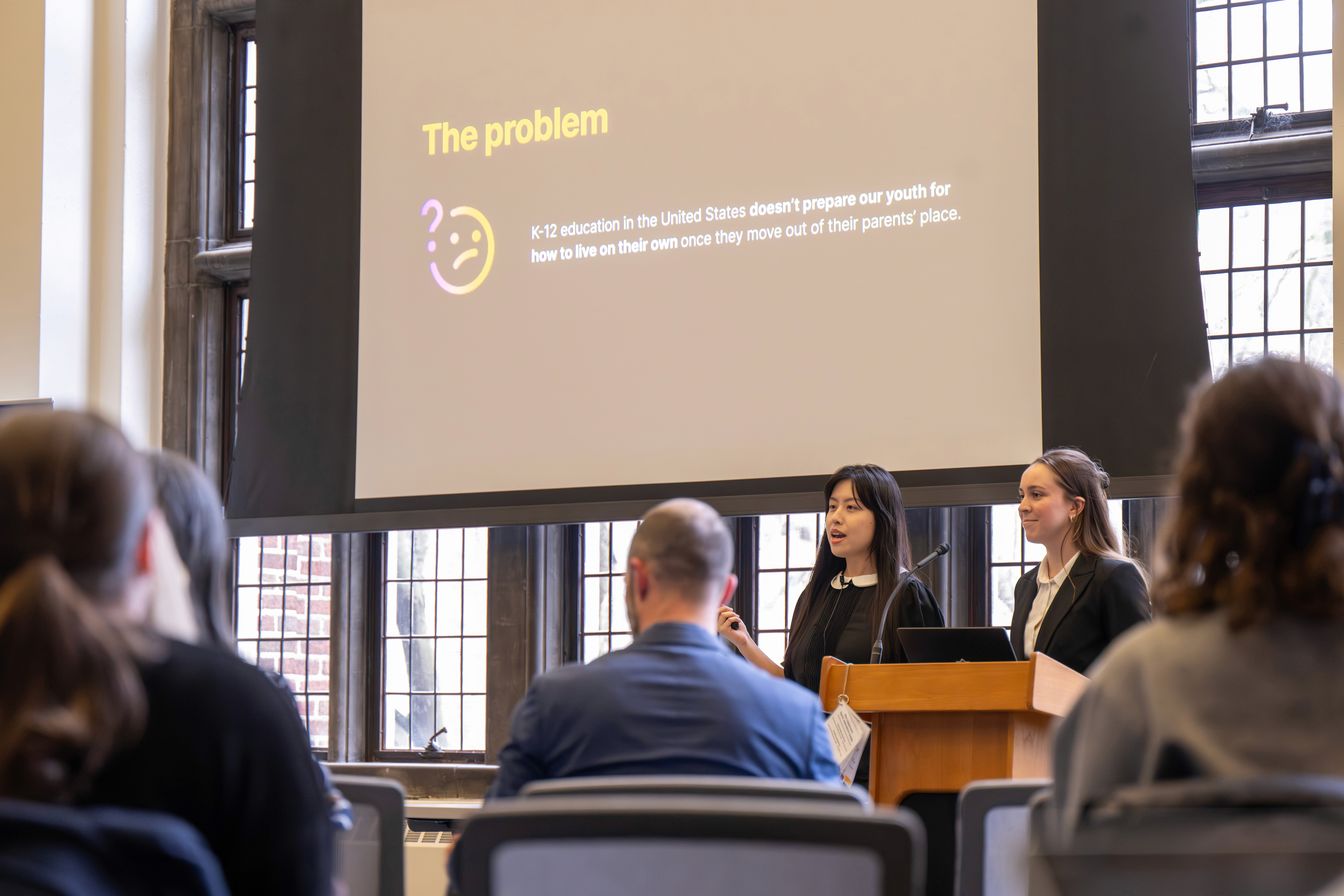
Pitching LevelUp Living to the Learning Levers judging panel.
UMSI Annual Student Project Exposition - April 2026. The School of Information's showcase of student capstone and thesis work. LevelUp Living placed 2nd in the Entrepreneurship and Innovation category and received a $500 prize.
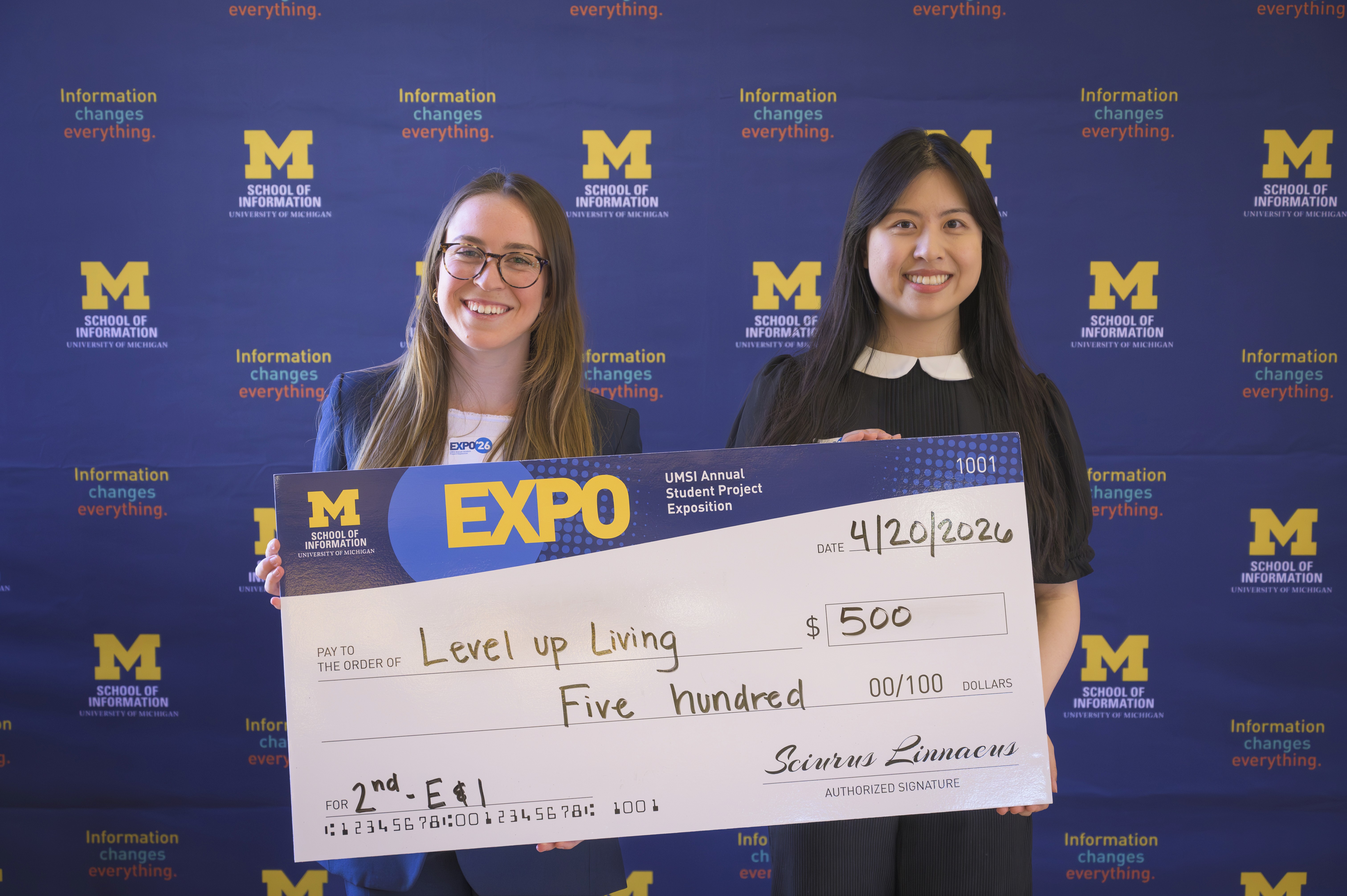
Accepting 2nd place and a $500 prize at UMSI EXPO 2026.

LevelUp Living exhibition booth at UMSI EXPO 2026.
Let's Connect!